
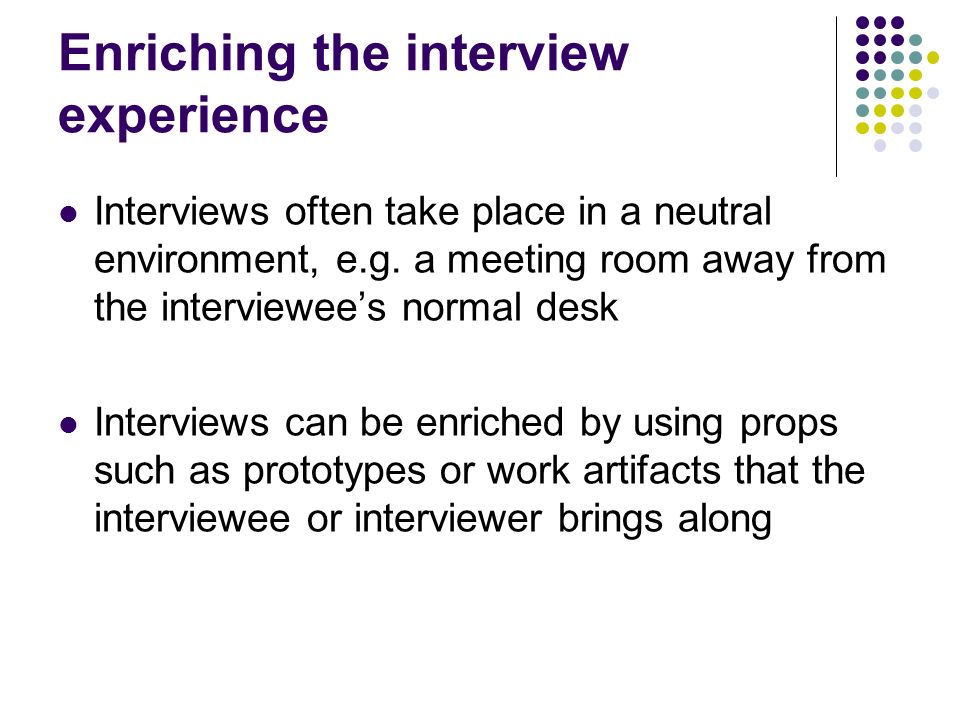
The act of enriching the interview experience is the process of making interviews more interesting for interviewees by grounding it in a specific context, and hopefully through that process increasing the value of the feedback received during the interview. Interviewers can enrich the process through the use of prototypes or other props.
This portion of the interviewing process is vital, because without it, it can be difficult to get useful and thorough answers from participants when they are not comfortable, or not engaged. Without proper data gathering, the design process can easily fail, and feedback is one of the key things to focus on to avoid that.
Along with engaging interviewees, using a prototype also provides context to any feedback you get through the interviews. Concrete answers tied to specific tangible problems that the interviewees have in front of them when providing their answers can provide some of the most useful feedback during the interview process as it allows the interviewees to point out on the prototype what issues they had with the design during the interview, and allows the interviewer to direct them towards providing more thorough answers.
I personally think making the interview process more engaging and comfortable for interviewees is one of the most important things one can do when gathering data. Before gathering data or designing a “perfect” product, interviewers have an ethical responsibility to their participants, and anything the interviewer can do to make the experience better for the interviewees providing one of the most valuable corporate resources in the form of data is something that should be a priority for the interviewer. Interviewees are very often participating voluntarily to provide a company with feedback that makes that company’s product better and should be treated in a way that reflects the value they provide.
References
Preece, Rogers, & Sharp, (2015). Interaction Design: Beyond Human Computer Interaction. West Sussex, United Kingdom: John Wiley & Sons, Ltd.
 Interaction Reflections