
When designing a product, it is important to understand the scope of the project and what you are actually attempting to accomplish with your design. In that regard, one must determine the exact requirements of the design, in order to focus their efforts and avoid a design that attempts to do everything while not actually accomplishing anything.
So the process of establishing requirements then has two major goals: to understand the users and why they need a product, and to set out a foundation of requirements that will help keep the design process focused.
Carrying that theme, there are also typically two kinds of requirements to consider during the the design process, functional and non-functional requirements. Functional requirements are ones that outline what the product should be able to do, while non-functional requirements are ones that act as restrictions or describe the constraints the product must be built within. For example, a functional requirement of a phone is that it must be able to send and receive phone calls and text messages, while a non-functional requirement is that the phone must be ready for mass production within the next year.
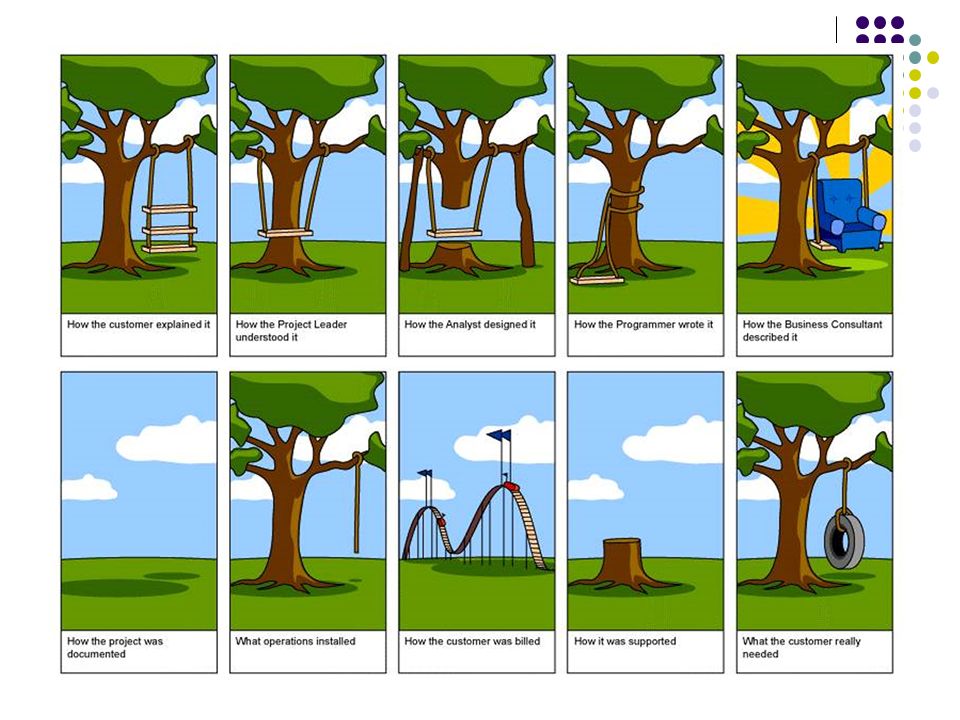
As the graphic above shows, everybody working on a product being on the same page with the requirements is important, to avoid situations in which customers are disappointed, investors are misled, programmer’s efforts are wasted, and ultimately the customer’s needs are not fulfilled. I think that before any design can actually begin, the requirements of the product should be laid out in terms that are understandable, and in a way that everybody can agree with, otherwise resources are wasted, customers are potentially lost, and all parties involved are left with a worse situation than what they started with.
References
Preece, Rogers, & Sharp, (2015). Interaction Design: Beyond Human Computer Interaction. West Sussex, United Kingdom: John Wiley & Sons, Ltd.
 Interaction Reflections